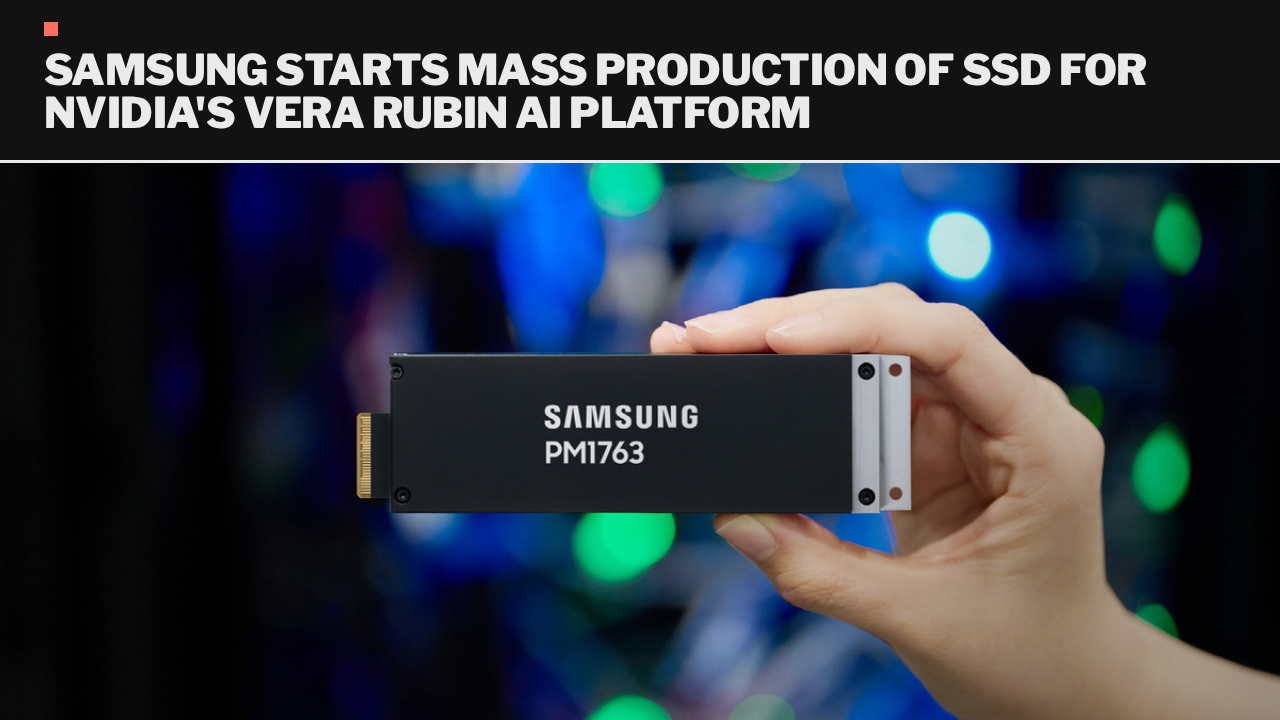
Samsung Electronics announced that it has begun mass production of its PM1763 enterprise solid state drive (SSD), designed for Nvidia’s Vera Rubin AI platform. The PM1763 is a PCIe 6.0-based storage solution targeted at next-generation AI and high-performance computing servers.
The PM1763 features Samsung’s 9th-generation V-NAND technology and a new 4-nanometer controller. It delivers sequential read speeds of up to 28,400 MB/s and write speeds of 21,900 MB/s in its 16TB configuration, more than doubling the performance of the PM1753. The drive can transfer a 40-gigabyte large language model in about 1.4 seconds.
Available in 4TB, 8TB, and 16TB capacities, the PM1763 is optimized for liquid-cooled server environments through direct-to-chip cooling technology. This design enables sustained peak performance during intensive workloads. Power efficiency has increased by over 1.8 times compared to the previous generation.
Jangseok Choi, Vice President and Head of Memory Product Planning at Samsung Electronics, stated, “Built on industry-leading performance, PM1763 has successfully completed validation for next-generation AI platforms and is well positioned to support evolving AI infrastructure requirements.”
Samsung first introduced the PM1763 at Nvidia’s GTC conference in March, where it also presented its HBM4 AI memory designed for the Vera Rubin architecture. At that event, Samsung confirmed that the PM1763 would act as the primary storage solution for the Vera Rubin platform.
This announcement is part of Samsung’s broader initiative to provide a comprehensive suite of memory and storage products for AI infrastructure. In June, Nvidia CEO Jensen Huang confirmed that Samsung, SK Hynix, and Micron Technology had all passed certification to supply HBM4 high-bandwidth memory for the Vera Rubin platform.
Furthermore, Samsung has incorporated post-quantum cryptography algorithms and TEE Device Interface Security Protocol support into the PM1763 to address emerging security concerns in AI data centers, including protection against potential quantum computing threats.