
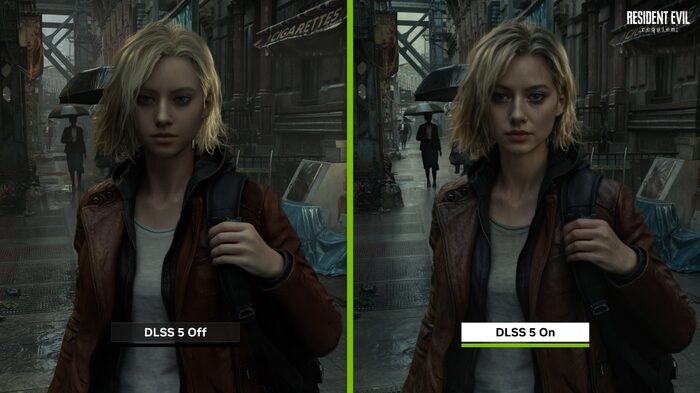
Nvidia has unveiled DLSS 5, a groundbreaking artificial intelligence graphics technology aimed at enhancing video game realism while reducing computational demands.
The DLSS 5 system combines traditional 3D graphics data with generative AI models to predict and complete image sections, allowing Nvidia’s GPUs to generate detailed scenes without individually rendering every component.
Nvidia CEO Jensen Huang explained that the company merged “controllable 3D graphics, the ground truth of virtual worlds, the structured data … with generative AI, probabilistic computing.” He noted, “One of them is completely predictive, the other one is probabilistic yet highly realistic.”
Huang stated that this fusion enables developers to create content that is “beautiful, amazing, as well as controllable.” He suggested that this integration of structured data and generative AI could expand beyond gaming into various sectors, including enterprise computing.
Huang cited enterprise data platforms such as Snowflake, Databricks, and BigQuery as examples of structured datasets that future AI systems could analyze. “In the future, what’s going to happen is these data structures are going to be used by AI, and AI is going to be much, much faster than us,” Huang said.
Nvidia’s gaming revenue currently constitutes a smaller portion of its total revenue compared to historical figures.