
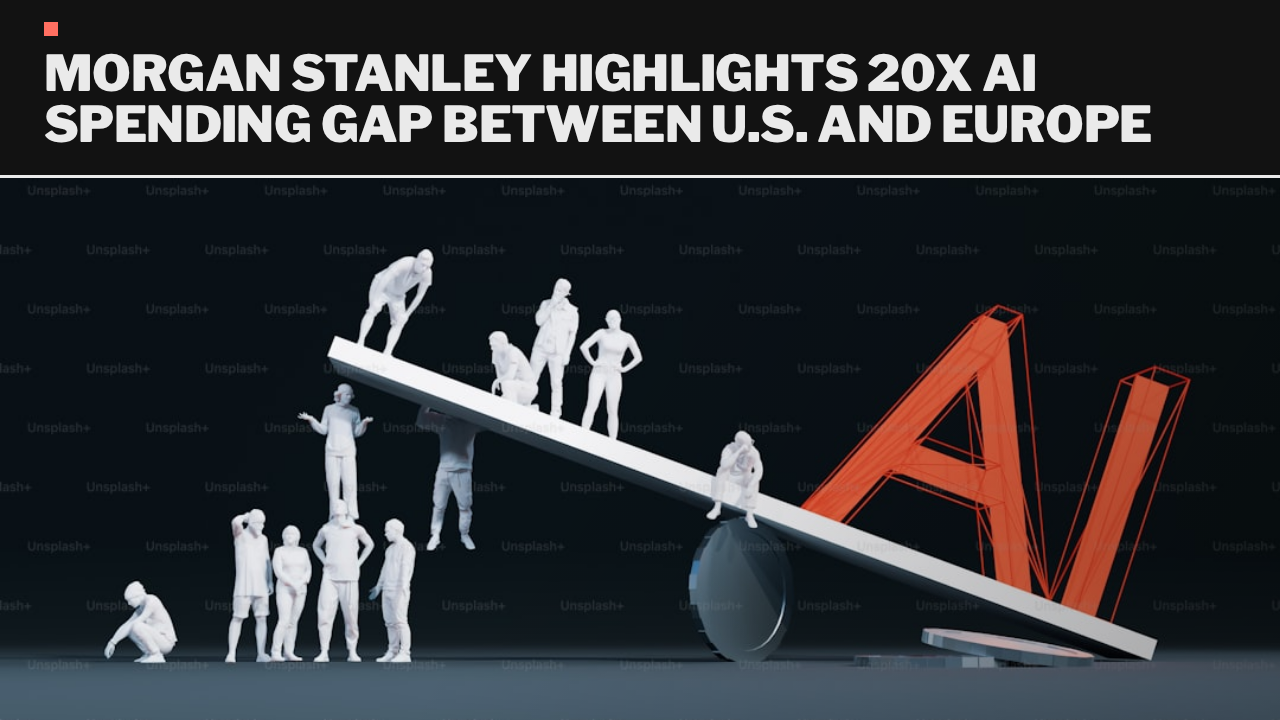
Morgan Stanley has warned that U.S. investment in artificial intelligence significantly exceeds European efforts by a factor of roughly 20. This disparity highlights a widening structural gap between the two regions that analysts say cannot be closed by a single policy measure.
The assessment was made during a Morgan Stanley discussion published on July 20, where a senior analyst stated, “it’s probably a factor of 20 that separates European investment plans from the plans we know that exist for the US.” This comment specifically referenced the capital expenditure commitments of seven major U.S. hyperscalers, including Amazon, Alphabet, Microsoft, and Meta, which are expected to invest approximately $700 billion in AI infrastructure by 2026. Yahoo Finance reported on July 21 that “just seven U.S. hyperscalers plan to spend 20 times more on AI than all of Europe.”
Morgan Stanley’s analysts noted that AI capital expenditure is contributing roughly 40 basis points to U.S. economic growth this year, with a similar contribution anticipated for next year. In Asia, AI and semiconductor company capital expenditure is projected to reach about $380 billion in 2026. In contrast, Europe lacks comparable commitments from both hyperscale platforms and domestic technology leaders.
The spending divergence is attributed to more than just corporate budgets. Morgan Stanley’s broader research indicates differences in capital allocation philosophy, regulatory environments, and the pace at which companies are integrating AI into their operations. A separate Morgan Stanley report from March projected that around $3 trillion of AI-related infrastructure investment will flow through the global economy by 2028, with more than 80 percent of that spending still to come.
Europe’s position is further complicated by the region’s tendency to require AI to “justify itself economically” rather than pursuing investment at scale. Additionally, Morgan Stanley recently increased its forecast for AI-driven job losses in European banking to 20 percent of the workforce by 2030. This suggests that Europe may experience the disruptions caused by AI without securing a proportionate share of its economic benefits.
The bank also pointed out an indirect consequence of the spending gap: approximately $55 trillion of the $180 trillion in U.S. household net worth has been generated in the past five years, driven in part by AI-related spending and optimism regarding future profitability. This wealth effect has supported consumer spending among upper-income households, thereby reinforcing the economic feedback loop that continues to widen the gap between the U.S. and Europe.