
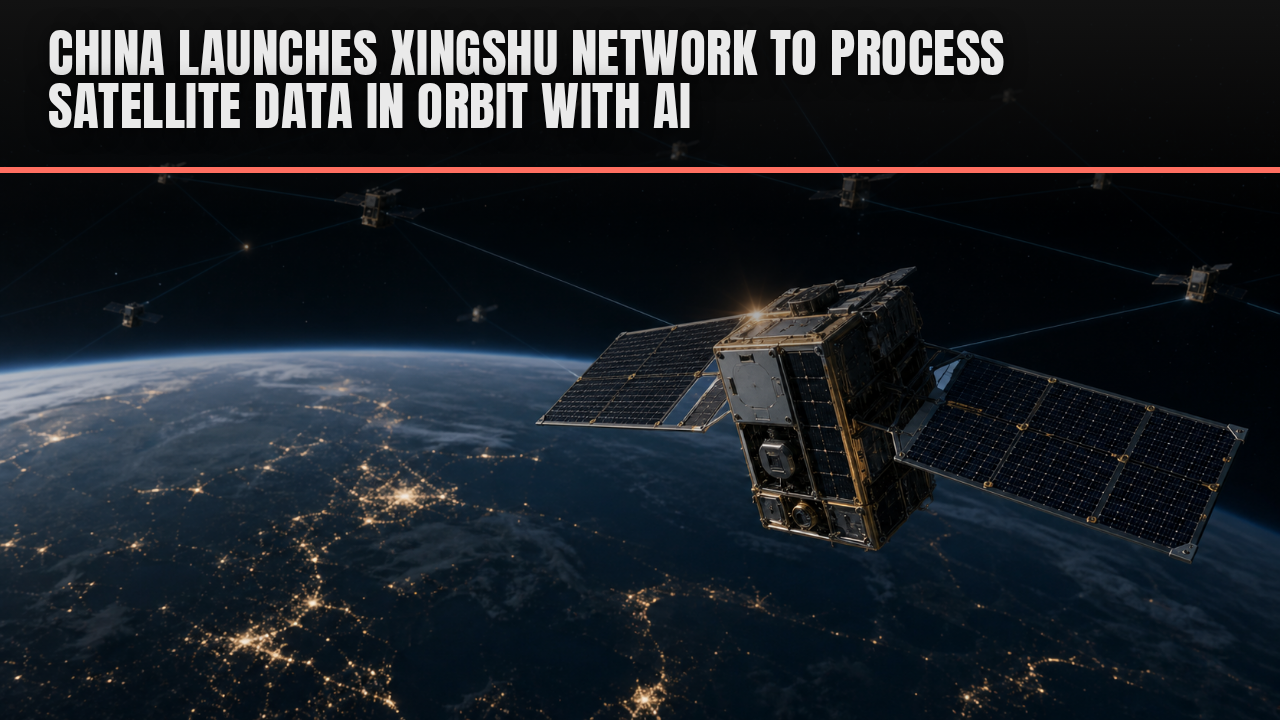
China has introduced a new space-based computing network designed to process satellite data in orbit using artificial intelligence (AI) before transmitting results to Earth. The project, named Xingshu or “Star Hub,” will consist of approximately 1,000 satellites, according to Chi Nan, an optical communications professor at Fudan University.
The network is a collaboration between Fudan University and Shanghai Xingshu Tiansuan Space Technology Co. It will provide on-demand, time-based computing services, enabling governments, researchers, and companies in sectors such as energy, shipping, and finance to rent computing power by the hour, Chi stated at the World Artificial Intelligence Conference in Shanghai.
Xingshu will integrate satellite observations with AI to deliver services such as weather forecasts, disaster warnings, port and shipping monitoring, and power grid inspections. These services will aid emergency responders, meteorological agencies, and natural resource authorities.
This initiative follows other Chinese space-computing projects, including the Tiansuan constellation, which consists of 300 satellites led by the Beijing University of Posts and Telecommunications, and the state-backed Zhejiang Lab’s 1,000-satellite Three-Body Computing Constellation. Tiansuan has launched eight satellites, while Three-Body deployed its first dozen satellites last year.
The concept behind space-based computing is that data generated in space should be processed in orbit. This approach allows satellites to analyze data and transmit only the relevant results back to Earth, facilitating real-time weather forecasts and disaster alerts while optimizing downlink capacity.
Chi explained that Xingshu’s architecture features a central computing satellite, referred to as a “space brain,” along with weather and Earth observation satellites. These satellites will be connected through laser communications, allowing them to collect data, execute AI models, and finalize analyses in orbit before sending results to Earth.
The development of the Xingshu network will occur in three phases, starting with an engineering demonstration that will include two computing satellites and 12 AI-enabled sensing satellites. The next phase will involve expanding the network to 50 computing and 100 AI-enabled sensing satellites, ultimately aiming for a constellation of 1,000 satellites.
In contrast, US tech entrepreneur Elon Musk’s SpaceX has proposed a different model for space-based computing. In January, it sought regulatory approval to deploy up to 1 million satellites as orbital AI data centers, arguing that the space environment offers abundant solar power and reduces the heavy water usage required for cooling data centers on Earth.
However, Chinese scientists contend that the country does not need to adopt Musk’s model, asserting that electricity is not a significant limitation for its AI data centers. They advocate for a focus on processing satellite-generated data in orbit and sending only essential information back to Earth, a strategy supported by the Xingshu, Tiansuan, and Three-Body constellations.
Western researchers have also expressed skepticism regarding Musk’s proposal, raising concerns about the cost and technical challenges associated with powering and cooling large-scale computers in orbit, as well as the environmental implications of producing, launching, and eventually de-orbiting such an extensive fleet.