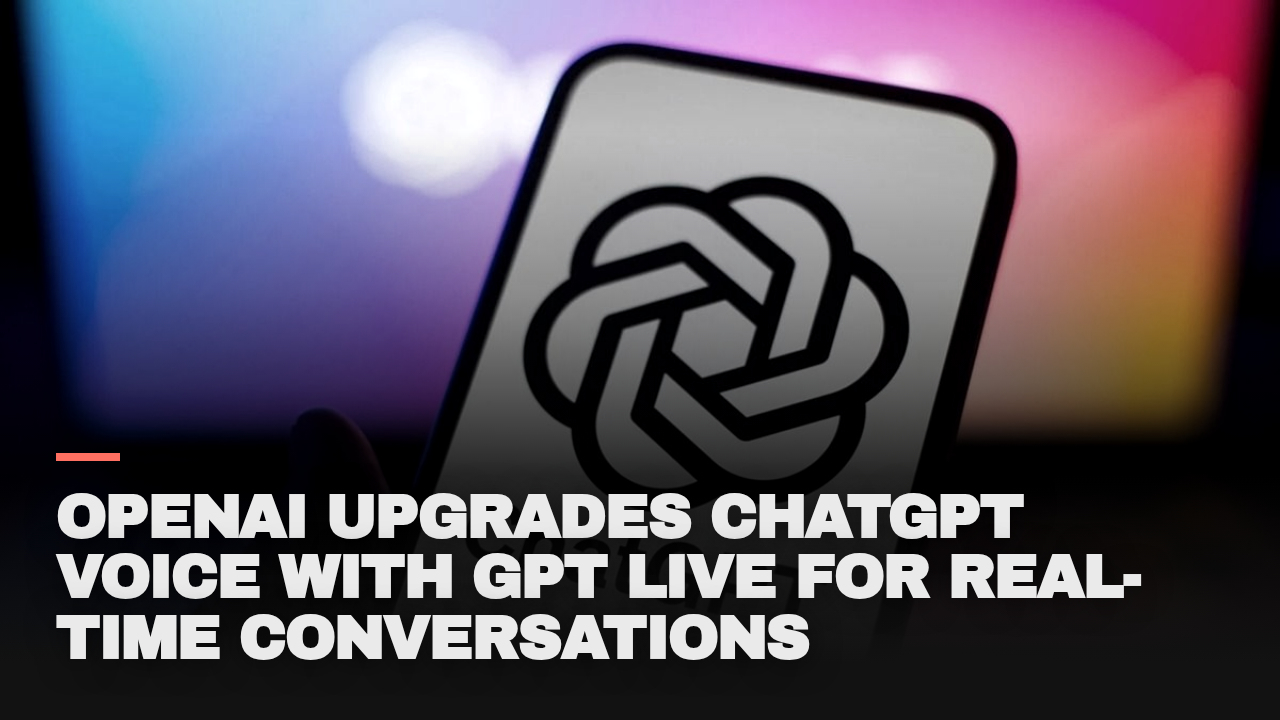
OpenAI has upgraded ChatGPT Voice with a new GPT Live system that enhances natural conversations, enables simultaneous listening and speaking, and improves responses using its latest AI models. The update introduces GPT Live 1 and GPT Live 1 mini, replacing the previous voice experience for users across various subscription tiers. This rollout affects ChatGPT on iOS, Android, the web, and CarPlay.
According to an OpenAI press release, the new voice models focus on making spoken interactions feel more fluid while allowing the assistant to manage complex requests in the background. OpenAI has started making GPT Live 1 and GPT Live 1 mini available to ChatGPT users globally, with API access planned for the future.
The new voice system employs a full-duplex architecture, which allows it to listen and respond simultaneously. Instead of waiting for a speaker to finish, the model continuously processes incoming audio to determine whether to reply, pause, continue listening, or use another tool. This approach facilitates faster conversations and supports features like live translation.
OpenAI stated that GPT Live separates voice interaction from advanced processing tasks. When a request requires web search, deeper reasoning, or agentic capabilities, the voice model hands off the task to another AI model while maintaining the conversation. The initial release uses GPT 5.5 as its reasoning model, although OpenAI expects future frontier models to replace it.
The company noted that GPT Live improves upon earlier voice technologies that relied on sequential speech-to-text, language, and text-to-speech models. It also succeeds the turn-based Advanced Voice Mode, which required users to stop speaking before receiving a response and could misinterpret pauses or background sounds as the end of a conversation.
OpenAI’s evaluations indicated that GPT Live 1 and GPT Live 1 mini outperform Advanced Voice Mode in overall conversation quality. The assessments measured conversational flow, interruptions, turn-taking, naturalness, and user preference. The company reported improvements in GPQA for scientific reasoning, BrowseComp for agentic web search, and its internal voice telecom benchmark.
The updated ChatGPT Voice experience enables more natural conversations by recognizing pauses without unnecessary interruptions. Users can interrupt the assistant, ask it to slow down, or request silence until needed. The model can also acknowledge that it is listening with brief verbal responses. OpenAI has refreshed the nine built-in ChatGPT voices for GPT Live.
The new system can access OpenAI’s latest frontier models to generate more capable responses. Users can select between Instant, Medium, and High reasoning modes based on their preference for reply speed or depth of reasoning. ChatGPT Voice can display visual cards on topics such as weather, stocks, and sports while also supporting search, memory, image handling, and file uploads.
OpenAI reported that the upgraded voice mode performs better in noisy environments by concentrating on the user’s speech. It can also accommodate longer pauses in conversations, making them feel less rigid.
The company emphasized that GPT Live incorporates dedicated safety measures for voice interactions. It expanded testing with audio-based evaluations and synthetic scenarios addressing issues such as self-harm, psychosis, mania, violence, sexual content, and emotional reliance on AI. Internal teams conducted red team testing to identify risks specific to spoken conversations.