
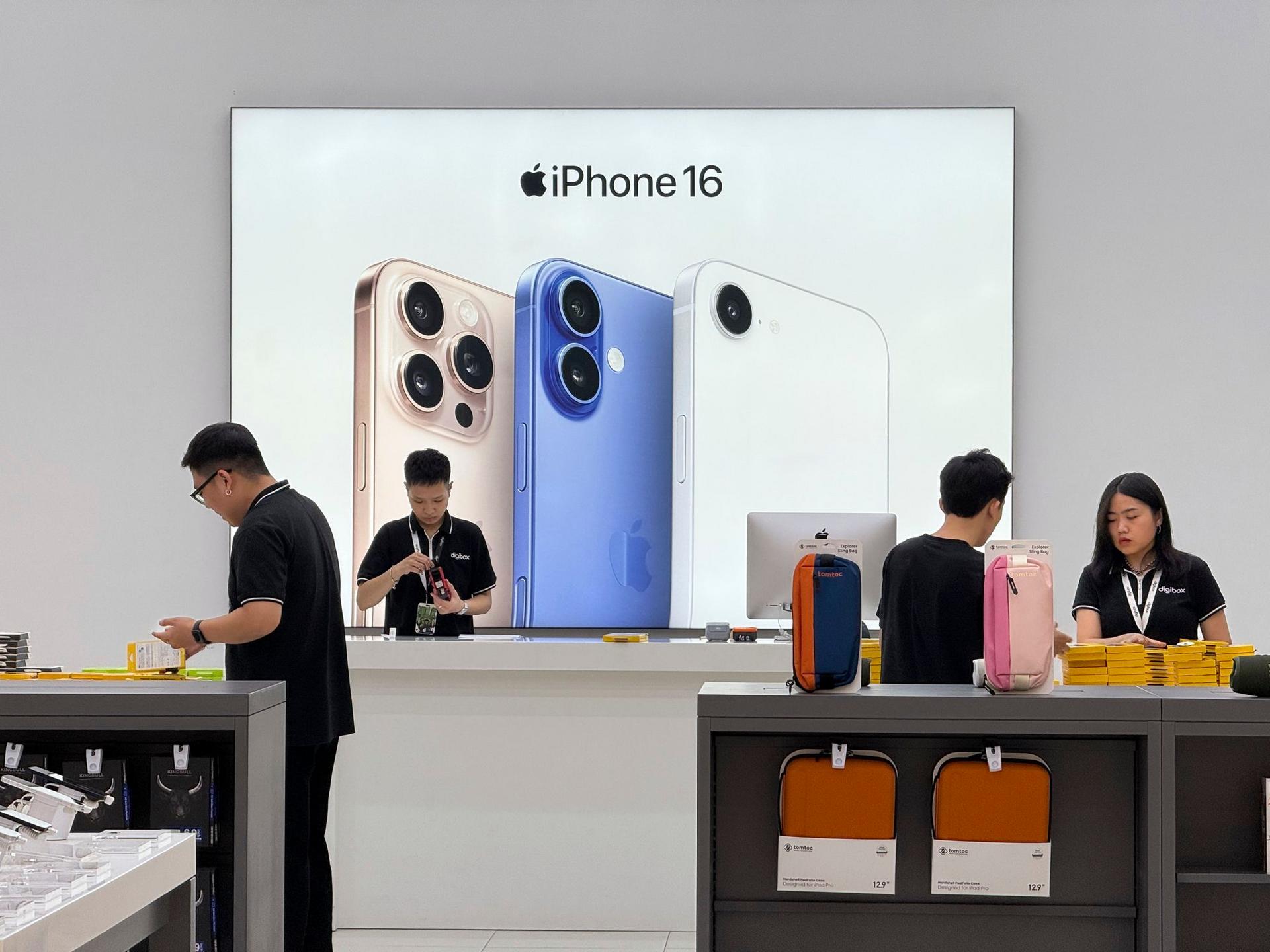
President Donald Trump’s push for Apple to manufacture iPhones in the United States in order to sidestep newly imposed tariffs has sparked sharp debate among technology analysts and rattled financial markets.
Trump has voiced strong support for the idea of reshoring iPhone production to American soil, arguing that the United States has both the workforce and resources necessary to build the company’s signature devices domestically. White House Press Secretary Karoline Leavitt underscored this stance on Tuesday, stating, “He believes we have the labor, we have the workforce, we have the resources to do it.” Leavitt further highlighted Apple’s $500 billion investment in the U.S., arguing, “If Apple didn’t think the United States could do it, they probably wouldn’t have put up that big chunk of change.”
Despite the administration’s confidence, skepticism has emerged from financial analysts regarding the feasibility and economic impact of such a move. Needham analyst Laura Martin responded to Leavitt’s comments on CNBC’s “The Exchange,” asserting, “I don’t think that’s a thing,” when asked about the possibility of shifting iPhone manufacturing entirely to the U.S. Martin elaborated that producing Apple’s marquee product domestically would cause the company’s costs to “skyrocket.” She was not alone in this assessment; Wedbush analyst Dan Ives estimated that if iPhones were built in the United States, the retail price could surge to $3,500 per device.
Martin also emphasized the immense complexity of relocating Apple’s intricate manufacturing and supply chain networks. She stated that the process would require years, echoing the consensus among supply chain experts that making iPhones entirely in the U.S. may not be possible at all. This is due in part to the existing global infrastructure Apple has developed, with significant portions of its production based in China, India, and Vietnam.
The context for Trump’s proposal is a rapidly shifting trade landscape. In a tit-for-tat escalation of trade tensions with China, the U.S. has imposed a cumulative tariff rate of 104% on Chinese goods, effective just after midnight. These tariffs extend beyond China, affecting other Apple manufacturing bases in India and Vietnam. As a result, Martin projected that Apple’s overall costs could rise by about 50%, intensifying the pressure to increase iPhone prices for U.S. consumers and potentially fueling inflation.
The market reaction to these developments has been swift and pronounced. Apple shares dropped nearly 2% in a single session Tuesday, and the stock has plunged around 20% over the past five trading days as investors digest the implications of Trump’s tariff plan. UBS analysts estimated on Monday that Apple might be forced to raise the price of its top-tier iPhone 16 Pro Max by as much as $350 for American buyers should the tariffs compel the company to pass on higher costs.
Martin warned that Apple consumers could bear the brunt of these increased expenses, which could, in turn, contribute to broader inflationary pressures. She advised investors to be cautious about buying Apple stock at this time, suggesting there may be further downside if tariffs are enacted in full or if additional geopolitical risks materialize. Martin cited possible retaliatory actions from China or instability in Taiwan as examples of scenarios that could compound Apple’s challenges, stating, “There’s lots of worst cases for Apple.”
Despite the ongoing volatility, most Wall Street analysts have yet to revise their earnings forecasts for Apple, citing the uncertainty surrounding trade policy and the ultimate outcome of the tariff dispute. The company’s existing strategy of diversifying manufacturing to multiple countries was developed in part to manage costs and enhance supply chain resilience amid earlier rounds of U.S.-China tensions. However, the new tariffs threaten to disrupt this delicate balance, leaving Apple and its investors navigating an uncertain path forward.


