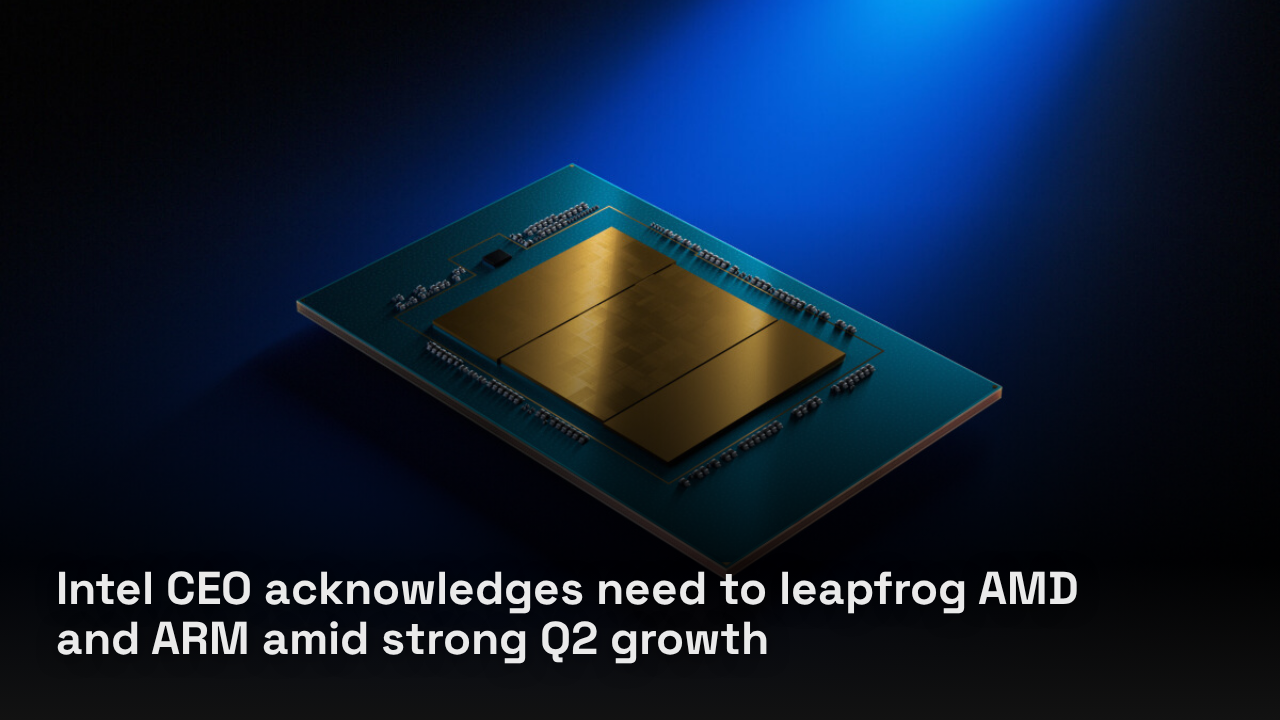
Intel CEO Lip-Bu Tan stated the semiconductor company must catch up to competitors AMD and Arm, noting expectations that edge AI and robotics will be as significant as its PC business. Tan made these remarks during Intel’s Q2 earnings call, where the company reported $16.1 billion in revenue, a 25 percent year-on-year increase.
Despite the revenue growth, Intel reported a GAAP loss of $11 billion and a non-GAAP loss of $2.2 billion. Tan described Q2 as a quarter of “solid execution,” indicating that revenue, gross margin, and earnings per share exceeded guidance. This marks the seventh consecutive quarter of surpassing financial expectations.
Tan expressed optimism about Intel’s future, attributing potential growth to the AI boom. He remarked, “Our core server CPU franchise is growing faster than ever,” and noted that the Xeon 6 range is among the fastest-ramping products in Intel’s history. However, Intel faces challenges as hyperscale customers increasingly design and deploy their own Arm-powered CPUs, leading to non-x86 servers accounting for nearly half of all sales, according to IDC.
AMD has captured a third of the x86 server market. When asked about regaining market share, Tan pointed to upcoming processors like Clearwater Forest, Diamond Rapids, and Coral Rapids, asserting these products will enhance Intel’s competitiveness. “Some areas we are still behind,” he admitted, “but we are catching up very fast and we try to leapfrog some of the CPU architecture, and we are putting major effort into it. Time will tell.”
Tan highlighted ongoing supply constraints impacting sales and revenue, stating, “The industry is facing one of the most severe supply constraints in its history, across leading-edge logic silicon wafers, memory, and substrates.” He noted that these shortages are expected to persist in the foreseeable future. Despite these constraints, Tan reported that wafer output exceeded expectations and yields from the 18A process are trending ahead of targets.
Intel’s near-term supply growth is expected to skew towards the end of Q3 and into Q4, particularly for server products. Tan provided positive updates on the foundry business, stating it is on track for 14A risk production in the second half of 2027, with a commitment to high volume ramp in 2028.
Regarding the flagship 18A process, Tan said it is now in volume production across multiple products. He emphasized the increasing factory output month-over-month and noted that the successful ramp of 18A validates Intel Foundry’s engagement with external customers.
Tan acknowledged the need for further work to establish a strong presence in the edge and physical AI ecosystem, which he sees as a critical growth driver. Intel has renamed its PC business to the “Client Computing and Physical AI Group” (CCPG). CFO David Zinsner stated that the edge and physical AI market could eventually match the client total addressable market, potentially making it an $8 billion business.
In the last quarter, 10 percent of CCPG’s $8.9 billion revenue stemmed from edge products, contributing to an overall 13 percent revenue increase.