Tekmono
  • News
  • Guides
  • Lists
  • Reviews
  • Deals
No Result
View All Result
Tekmono
No Result
View All Result
Home News
Intel launches Starfire, its first advanced space-grade processor

Intel launches Starfire, its first advanced space-grade processor

by Tekmono Editorial Team
13/07/2026
in News
Share on FacebookShare on Twitter

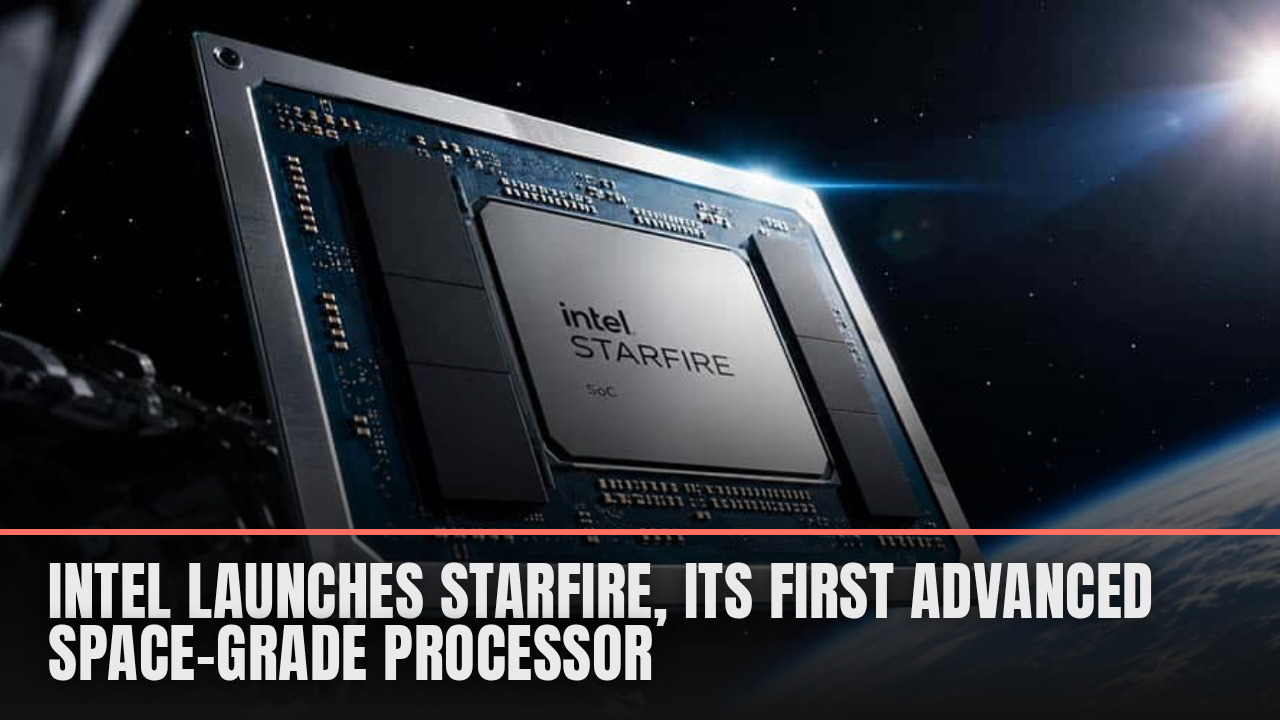
Intel has unveiled its Starfire processor, the first space-grade system-on-chip built on the company’s 18A process node. This marks the initial application of Intel’s advanced manufacturing technology for use in orbit.

The Starfire is an eight-core SoC that utilizes Foveros advanced 3D chip-stacking technology, combining two chiplets, each with four P-Cores. It features LPE-Cores that can reach up to 2.1 GHz, while the GPU is clocked at 2.0 GHz. The processor delivers 75 TOPS of AI performance and operates within a 35W thermal design power envelope, with the P-core frequency listed at 3.1 GHz.

According to Intel’s product documentation, the Starfire is designed for space-grade survivability and advanced AI performance while adhering to the size, weight, and power constraints required for spacecraft systems. The chip can operate at temperatures up to 125°C and withstand radiation exposure typical in space environments.

Related Reads

AMD set to showcase first Zen 6 Epyc Venice CPUs at Advancing AI summit

Insta360 X6 leak shows compact design and pricing ahead of launch

False Echo, a WWII cryptography thriller, announced for PC

Robinhood introduces AI trading agents for crypto as 70,000 join beta program

The Starfire signifies a significant expansion of Intel’s 18A process technology beyond consumer and data center applications. Intel first introduced 18A with the Core Ultra Series 3 processors at CES in January 2026, and the 18A-P variant entered risk production in June 2026, featuring enhanced thermal characteristics.

Space-grade processors have traditionally lagged behind commercial silicon in terms of process nodes due to rigorous radiation hardening and reliability requirements. Competitors in the space processor market include Microchip Technology’s radiation-tolerant PolarFire SoC FPGA and various SPARC-based radiation-hardened designs.

The Starfire’s integration of AI acceleration, modern CPU architecture, and space-grade reliability could enhance computational capabilities aboard satellites and spacecraft. With its 75 TOPS of neural processing power in a 35W package, the chip presents a significant advancement over existing space-qualified processors, which have often prioritized fault tolerance over performance. Intel has not provided details on specific launch customers or availability timelines for the Starfire.
Tags: Apple IntelligenceProduct LaunchSpace-grade
ShareTweet

You Might Be Interested

AMD set to showcase first Zen 6 Epyc Venice CPUs at Advancing AI summit
News

AMD set to showcase first Zen 6 Epyc Venice CPUs at Advancing AI summit

13/07/2026
Insta360 X6 leak shows compact design and pricing ahead of launch
News

Insta360 X6 leak shows compact design and pricing ahead of launch

13/07/2026
False Echo, a WWII cryptography thriller, announced for PC
News

False Echo, a WWII cryptography thriller, announced for PC

13/07/2026
Robinhood introduces AI trading agents for crypto as 70,000 join beta program
News

Robinhood introduces AI trading agents for crypto as 70,000 join beta program

13/07/2026
Please login to join discussion

Recent Posts

  • AMD set to showcase first Zen 6 Epyc Venice CPUs at Advancing AI summit
  • Insta360 X6 leak shows compact design and pricing ahead of launch
  • False Echo, a WWII cryptography thriller, announced for PC
  • Robinhood introduces AI trading agents for crypto as 70,000 join beta program
  • Major U.S. banks join U.K. tokenization taskforce to reshape financial markets

Recent Comments

No comments to show.
  • News
  • Guides
  • Lists
  • Reviews
  • Deals
Tekmono is a Linkmedya brand. © 2015.

No Result
View All Result
  • News
  • Guides
  • Lists
  • Reviews
  • Deals

This website uses cookies to improve your experience. You can choose to accept or reject them. Visit our Privacy Policy.