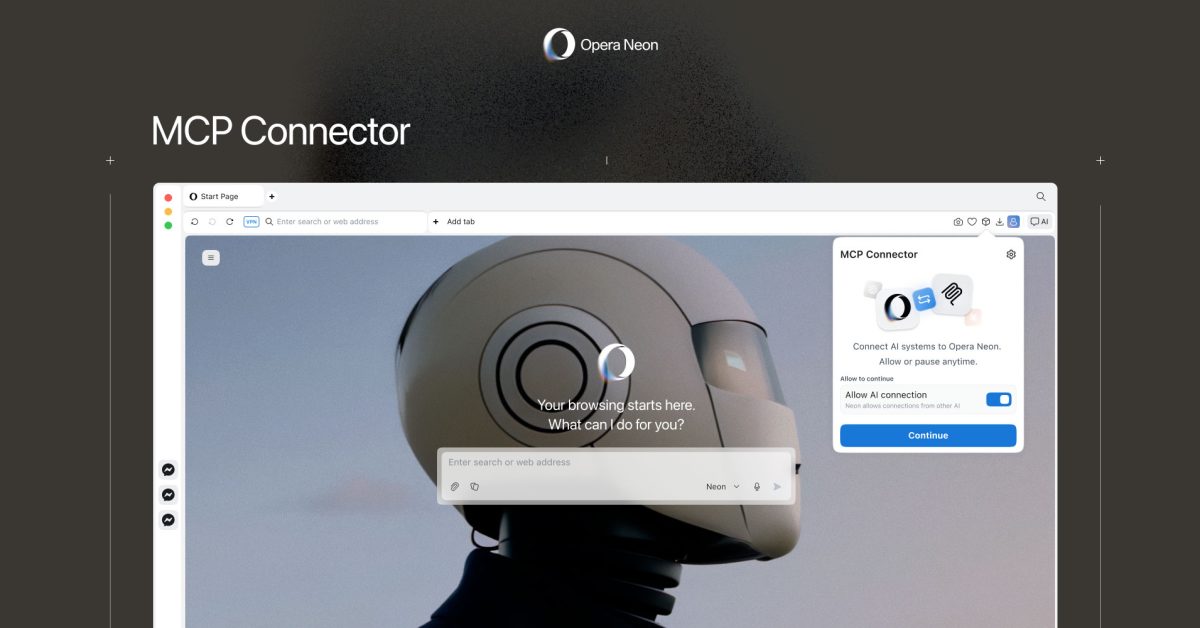
Opera has integrated AI tool connectivity into its agentic browser, allowing users to directly connect various AI models to their live browsing sessions. This new capability enables users to access tabs and interact with web pages in real time using AI tools.
The integration is built on the Model Context Protocol (MCP), an open standard developed by Anthropic and donated to the Linux Foundation’s Agentic AI Foundation. MCP facilitates the connection between AI models and external systems, and its adoption by multiple companies allows tools like ChatGPT, Gemini, and Claude to interact with applications such as Notion, Google Drive, Slack, GitHub, and Zapier.
Opera Neon, the company’s subscription-based browser launched last year, features built-in agentic tools designed to enhance productivity. These tools include Tasks, which serve as self-contained workspaces for comprehensive analysis, Cards for saving frequently used prompts, Do for navigating on behalf of the user, and Make, a feature for creating widgets and reports.
The latest update for Opera Neon adds support for MCP, enabling AI tools including ChatGPT, Claude, Lovable, n8n, and OpenClaw to access user tabs and perform actions. This functionality can significantly enhance user productivity by minimizing context switching and allowing AI-driven performance of tasks that span multiple steps.
Opera highlighted that these efficiencies will be particularly beneficial for users familiar with MCP-ready tools. The new updates also provide an entry point for new users looking to explore these advanced workflows within Opera Neon.
Opera Neon continues to evolve, having previously incorporated features like deep research capabilities and integration with Gemini 3 Pro, indicating a commitment to enhancing the tool’s functionality for its subscribers.